When Your Coping Mechanisms Become Your Personality

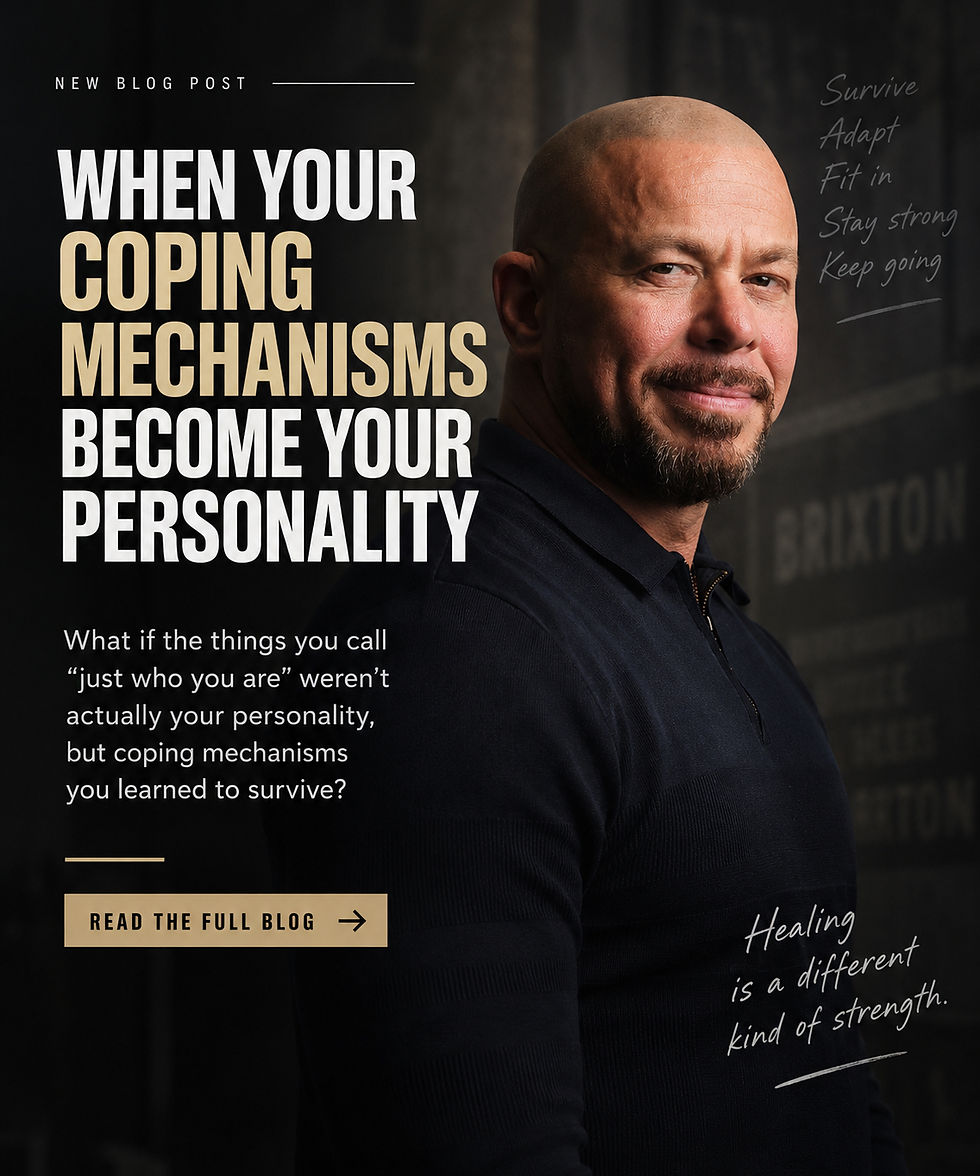
Have you ever said, “That’s just who I am”?
Maybe you’re someone who gets angry quickly.
Maybe you don’t trust people easily.
Maybe you like being in control.
Maybe you never ask for help.
Maybe you always have to be the strong one.
Maybe you use humour when things get uncomfortable, or you keep yourself busy so you don’t have to think too much.
We often describe these things as personality traits.
“That’s just me.”
“I’ve always been like this.”
“I don’t need anyone.”
“I’m just independent.”
“I’ve got a short temper.”
“I don’t do emotions.”
But what if some of these things aren’t actually who you are?
What if they are things you learned to do because, at some point in your life, you needed them to survive?
That’s something I think we don’t talk about enough.
A coping mechanism is something we develop to help us manage something that feels difficult, threatening, painful or overwhelming.
And coping mechanisms can be incredibly useful.
As children, we learn very quickly what gets us through difficult situations.
Maybe you learned to stay quiet because speaking up caused problems.
Maybe you learned to make people laugh because humour helped take the tension away.
Maybe you became the responsible one because nobody else was.
Maybe you learned not to rely on anyone because the people you needed weren’t always there.
Maybe you became angry because anger made people back off.
Maybe you became very independent because asking for help left you feeling disappointed.
At the time, these behaviours made sense.
They helped you cope.
The problem is that something that helped you survive one environment can become a problem when you carry it into another.
You might grow up and still feel like you have to protect yourself from things that are no longer happening.
And eventually, the coping mechanism can become so familiar that you stop seeing it as something you do.
You start seeing it as who you are.
I know this personally.
When I look back at my teenage years, my twenties and even parts of my early thirties, there were coping mechanisms that had become so much a part of me that I genuinely believed they were my personality.
Growing up in Brixton, around crime, violence, prison and addiction, there were certain ways you learned to behave if you wanted to fit in, protect yourself and get through life.
Being vulnerable wasn’t necessarily going to help you.
Looking weak could have consequences.
You learned who to trust and who not to trust.
You learned how to read a room.
You learned how to protect yourself.
You learned how to fit in.
You learned how to survive.
And when you live like that for long enough, survival can start to feel normal.
People who knew me back then sometimes think they know me now because they knew me years ago.
But they’re talking about a completely different man.
That doesn’t mean that the person I was back then wasn’t me.
He was.
He was just a version of me who had learned how to survive in the environment he was in.
And I think that’s an important distinction.
Because sometimes we look back at ourselves and think, “What’s wrong with me?”
But maybe a better question is, “Why did I need to become this way?”
There is a difference.
You might think you’re an angry person, but maybe anger was the safest emotion available to you.
You might think you’re cold, but maybe being emotionally distant stopped you from getting hurt.
You might think you’re controlling, but maybe control became important because your early life felt unpredictable.
You might think you’re a people pleaser, but maybe keeping everyone happy was how you learned to avoid conflict.
You might think you’re fiercely independent, but maybe somewhere along the way you learned that depending on people wasn’t safe.
And this doesn’t mean we should excuse behaviour that hurts ourselves or other people.
Understanding where something comes from doesn’t mean we have to accept it forever.
It means we can start to understand it.
And once we understand something, we have a much better chance of changing it.
One of the difficult things about changing is that other people don’t always like it.
When you’ve spent years being the person who always says yes, people might be surprised when you start saying no.
When you’ve always been available, people might call you selfish when you start putting boundaries in place.
When you’ve always been the strong one, people might not understand when you finally admit that you’re struggling.
When you’ve changed the way you behave, people who benefited from the old version of you may tell you that you’ve changed.
And they’re right.
You have.
But changing doesn’t necessarily mean you’ve become worse.
Sometimes it means you’re finally becoming more yourself.
This is where therapy can be really useful.
Therapy isn’t about trying to turn you into somebody you’re not.
It’s about creating enough space to understand who you are underneath all the things you’ve had to become.
We can start looking at where certain behaviours came from.
When did you learn to be like this?
What were you protecting yourself from?
What happens inside you when you don’t feel in control?
Why is asking for help so difficult?
What are you afraid might happen if you let somebody get close?
And perhaps most importantly, what would happen if you didn’t have to survive anymore?
Because sometimes the hardest part isn’t letting go of the coping mechanism.
It’s discovering who you are without it.
You might find that you’re not actually an angry person.
You’re someone who learned anger kept you safe.
You might find that you’re not cold.
You’re someone who learned that vulnerability came with a cost.
You might find that you’re not incapable of trusting.
You’re someone who hasn’t yet experienced enough safety to learn how.
And you might discover that underneath all that independence, strength and control is somebody who has actually wanted connection all along.
We don’t need to hate the person we used to be.
We don’t need to be ashamed of the things we did to get through difficult periods of our lives.
Sometimes we just need to recognise that what helped us survive then might not be helping us live now.
Because coping mechanisms are supposed to help us cope.
They’re not supposed to become our entire identity.
Final Thought
Maybe you’re not broken.
Maybe you’re not difficult.
Maybe you’re not just an angry person, a cold person, a controlling person or someone who doesn’t need anybody.
Maybe you’ve been carrying certain ways of surviving for so long that you’ve mistaken them for your personality.
And perhaps the real question isn’t, “What’s wrong with me?”
Perhaps it’s:
“Who could I be if I no longer had to survive?”
Jr Atkins MNCPS


Great read
There must have been a reason that I came accross this blog post this morning - I was meant to read this today! Thank you